
Always the Responsible One? Overfunctioning, ADHD, and Anxiety Explained
In many relationships, there’s often one person who quietly becomes the responsible one.
Not because they were asked to.
Not because they planned to.
It just slowly happens.
They become the planner.
The fixer.
The emotional manager.
The one who holds everything together when life feels messy or overwhelming.
They remember appointments.
They smooth over conflict before it turns into a fight.
They anticipate problems before anyone else notices them.
They pick up the slack when things don’t get done.
They regulate not only their own emotions, but often their partner’s, their family’s, and even their coworkers’ too.
They carry the mental load.
At first, this role can feel good.
It feels like love.
Like being dependable.
Like being the strong one people can count on.
Like finally having a sense of control in a world that often feels chaotic.
For many people with ADHD or anxiety, stepping into this role can even bring a sense of relief. When your brain is always scanning for what might go wrong, staying on top of everything feels safer than letting things unfold on their own. When your nervous system is wired for urgency and responsibility, doing more feels like the best way to calm the stress.
But slowly, quietly, the cost starts to show up.
What once felt like caring turns into carrying.
What once felt like responsibility turns into pressure.
What once felt like connection turns into exhaustion.
Over time, many overfunctioners begin to feel anxious, burnt out, resentful, and strangely alone in their relationships. They may love deeply, yet feel like they are doing life by themselves. They may crave rest, but feel unable to relax because everything seems to depend on them.
This pattern is called overfunctioning.
And while it often becomes most obvious in romantic relationships, it doesn’t stop there. Overfunctioning commonly shows up in friendships where you’re always the strong one, at work where you become the fixer and problem-solver, and in parenting where you carry the emotional and practical load of the family.
It is especially common in individuals with ADHD, anxiety, and OCD-like tendencies. When the nervous system is already wired to stay alert, prevent problems, and manage stress, overfunctioning becomes a natural coping strategy. It’s the brain’s way of trying to create safety through control and responsibility.
The challenge is that what once protected you can slowly begin to drain you.
What Overfunctioning Really Is (And What It Isn’t)
Overfunctioning happens when one person consistently takes on more emotional, mental, and practical responsibility in a relationship than is healthy or sustainable.
It’s not just being helpful.
It’s not simply being responsible.
It’s not caring too much.
Overfunctioning is when you begin carrying what was never meant to be carried by one person alone.
It often starts quietly and with good intentions. You step in to help when something is stressful. You take over when something feels overwhelming. You fix problems because you can see the solution faster. You manage emotions because conflict feels uncomfortable or unsafe.
Over time, this helping role becomes your default position in relationships.
Common ways overfunctioning shows up include:
• managing other people’s emotions so things stay calm
• fixing problems before anyone asks for help
• taking over tasks because it feels easier, faster, or safer
• constantly thinking ahead to prevent mistakes or stress
• feeling responsible for other people’s moods, success, or failures
• struggling to relax because something always needs attention
For many people with ADHD and anxiety, this can be driven by a brain that’s always scanning for what might go wrong. Anticipating, planning, and fixing becomes a way to soothe stress and create a sense of control.
Healthy functioning looks very different.
Healthy functioning means you can handle your own responsibilities, regulate your emotions, make decisions, and also allow others to carry their share. It includes being able to lean on people when needed, while still trusting them to manage their own lives.
Overfunctioning happens when support slowly turns into control.
When responsibility turns into rescuing.
When helping turns into carrying everything.
Instead of two people sharing life together, one person becomes the emotional and practical engine of the relationship while the other gradually steps back.
What starts as caring often ends in imbalance.
And while the overfunctioner may look strong on the outside, inside they are often overwhelmed, anxious, and exhausted.
In healthy relationships there is interdependence.
In overfunctioning relationships, there is imbalance.
Recognizing this difference is the first step toward building relationships that feel lighter, safer, and more connected.
Why ADHD and Anxiety Make Overfunctioning More Likely
For many people with ADHD or anxiety, overfunctioning doesn’t come from wanting control. It develops as a coping strategy.
It’s the nervous system’s way of trying to create stability in a world that often feels overwhelming, unpredictable, or unsafe.
With ADHD, life can feel chaotic. You may have struggled with forgetfulness, missed deadlines, emotional intensity, or being told you were disorganized or “too much.” Over time, many people swing in the opposite direction as a form of self-protection. They become hyper-aware, overly prepared, and deeply responsible.
Instead of chaos, they aim for control.
Instead of mistakes, they aim for perfection.
Instead of falling behind, they aim to stay ten steps ahead.
Fixing problems quickly, managing details, and taking over responsibilities becomes a way to prevent stress before it starts.
With anxiety and OCD-like traits, the brain is constantly scanning for danger, discomfort, or things that could go wrong. Thoughts move quickly to worst-case scenarios. The body stays in a state of alertness.
Overfunctioning becomes a way to calm that constant tension.
If you handle everything now, nothing bad will happen later.
If you stay in control, you can avoid chaos.
If you manage everyone’s emotions, there won’t be conflict.
It often sounds like:
“If I take care of it now, I won’t have to worry later.”
“If I don’t step in, something will fall apart.”
“If I stay on top of everything, I can finally relax.”
The problem is that the nervous system rarely feels satisfied.
Once one thing is handled, the brain immediately scans for the next potential issue. There is always another task, another emotion to manage, another problem to prevent.
For people with ADHD and anxiety, overfunctioning can feel productive, responsible, and even soothing in the short term. But over time, it keeps the body stuck in stress mode and teaches the brain that rest is only allowed once everything is perfect.
And since life is never perfect, the relaxing never actually comes.
Instead, overfunctioning becomes a nonstop cycle of doing, fixing, managing, and carrying more than one person was ever meant to hold.
Overfunctioning in Romantic Relationships
This is usually where the overfunctioning pattern becomes the most painful and visible.
What often starts as helping slowly turns into one partner carrying the relationship.
One person gradually becomes the organizer, the emotional regulator, the decision maker, and the problem solver. They keep track of schedules, manage finances, anticipate stress, smooth over conflict, and often take responsibility for their partner’s emotions too.
They don’t just do things.
They think about everything.
They carry the mental load of the relationship.
Meanwhile, the other partner usually doesn’t mean to underfunction. In many cases, they appreciate the help at first. But over time, as the overfunctioner consistently steps in, they naturally begin stepping back. Decisions are made for them. Problems are solved before they even have a chance to engage. Responsibilities slowly shift onto one person’s shoulders.
The dynamic forms quietly.
Common signs of overfunctioning in romantic relationships include:
• making most of the decisions, big and small
• reminding your partner about appointments, tasks, and responsibilities
• fixing emotional blowups or preventing conflict before it escalates
• managing stress for both people
• carrying the mental load of planning, organizing, and anticipating needs
• feeling like you’re parenting instead of partnering
For many people with ADHD or anxiety, this pattern often comes from a deep fear of chaos, conflict, or things being forgotten or mishandled. When your brain is wired to anticipate problems, stepping in feels safer than waiting. Taking control feels easier than tolerating uncertainty.
At first, it can feel helpful.
It can feel like teamwork.
It can feel like love.
It can feel like you’re keeping the relationship running smoothly.
But over time, the emotional weight grows heavier.
Instead of feeling supported, the overfunctioner often starts feeling tired, overwhelmed, and alone. They may wonder why they are doing so much while their partner seems disengaged or passive. They may feel guilty for wanting things to change, yet resentful that nothing feels shared.
Resentment rarely arrives all at once.
It usually builds quietly through small moments of exhaustion, disappointment, and feeling unseen.
And without awareness, this pattern can slowly turn a romantic partnership into something that feels more like a parent-child dynamic than two equal adults walking through life together.
Overfunctioning in Friendships
Overfunctioning doesn’t stop at romantic relationships. In fact, many people first notice this pattern in their friendships long before they see it at home.
It often turns someone into:
the therapist friend
the planner friend
the reliable friend
the one everyone leans on
You may find yourself constantly listening, offering advice, checking in, remembering important dates, organizing hangouts, helping during crises, and emotionally holding space for others.
People know they can come to you when life feels hard.
And you usually show up.
For individuals with ADHD, this can look like hyper-focusing on helping, overcommitting, and saying yes before checking your own capacity. Helping feels meaningful and engaging, but it can quickly turn into doing too much.
For those with anxiety, overfunctioning in friendships often comes from people-pleasing and a deep fear of letting others down. You may worry that if you stop showing up so much, people will pull away or be disappointed in you.
Over time, many overfunctioners begin to notice a painful pattern.
They show up for everyone.
But very few people show up for them.
They may feel drained after social interactions instead of supported. They may feel needed, but not truly cared for. They may begin pulling back out of exhaustion, guilt, or quiet resentment.
Burnout in friendships is incredibly common with overfunctioning, especially for people with ADHD and anxiety who already carry a heavy emotional load.
Overfunctioning at Work
You become the go-to person.
The fixer.
The one who catches mistakes before they happen.
The one who stays late, takes on extra projects, and keeps things running smoothly.
Managers rely on you.
Coworkers lean on you.
Systems quietly depend on you.
For people with ADHD and anxiety, this often comes from deeper fears and pressures such as:
• fear of messing up or being seen as unreliable
• perfectionism and high self-standards
• needing to overperform to feel secure or valued
• constantly anticipating problems before they happen
You may feel like if you don’t stay on top of everything, things will fall apart.
And for a while, this high level of responsibility may bring praise, promotions, or recognition.
But internally, many overfunctioners feel tense, exhausted, and unable to ever truly rest.
The result is often high performance paired with chronic stress, emotional fatigue, and eventually resentment.
Many people burn out not because they aren’t capable, but because they’ve been carrying far more than their share for far too long.
Overfunctioning in Parenting
In parenting, overfunctioning often shows up as doing everything for your children emotionally and practically.
You may find yourself:
• managing all schedules, routines, and responsibilities
• fixing emotional distress quickly to avoid meltdowns or discomfort
• removing struggles instead of letting kids problem solve
• carrying the entire mental load of the household
For anxious parents, this often comes from a fear of discomfort, failure, or something going wrong. It can feel unbearable to watch your child struggle or be upset.
For parents with ADHD, overfunctioning may turn into hyper-management as a way to avoid chaos, forgetfulness, or overwhelm.
While this pattern is rooted in deep love and care, it can unintentionally limit children’s independence and leave parents feeling completely depleted.
Instead of parenting feeling shared, it often feels like one person carrying the family emotionally and practically.
Why Overfunctioning Creates Distance Instead of Closeness
When one person consistently overfunctions, others naturally begin to underfunction.
Not because they are lazy or uncaring, but because the system quietly shifts.
Over time:
one person carries most of the responsibility
the other steps back more and more
imbalance becomes the new normal
The emotional toll on the overfunctioner grows.
Burnout sets in.
Resentment builds quietly.
Loneliness creeps into relationships.
Frustration becomes constant.
And intimacy often drops because the relationship begins to feel less like equal partners and more like a parent-child dynamic.
Connection thrives on balance, not control.
The Overfunctioning Cycle
For many clients, the cycle looks something like this:
Anxiety rises → control increases
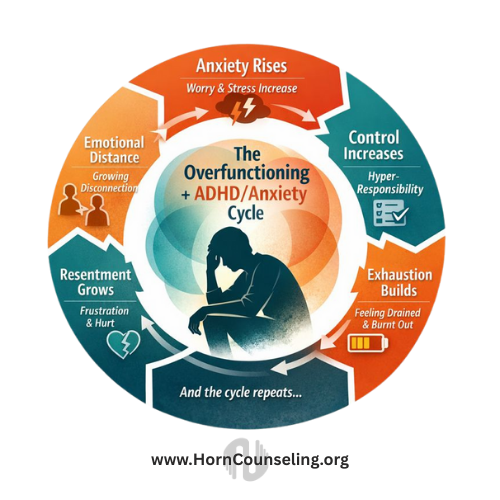
Control increases → exhaustion builds
Exhaustion builds → resentment grows
Resentment grows → emotional distance forms
Distance increases → anxiety spikes again
And the pattern repeats.
Without awareness and intervention, this cycle can continue for years.
How Therapy at Horn Counseling Helps Break the Pattern
In therapy, we don’t simply tell clients to “do less” or “set boundaries.”
We help you understand:
• where overfunctioning started
• which parts of you are driving it
• how ADHD and anxiety intensify the cycle
• how to safely shift responsibility
• how to build emotional balance and trust
Clients gradually learn to:
• tolerate discomfort without rescuing
• trust others to step up and engage
• communicate needs clearly and directly
• release control in manageable steps
• reconnect without carrying everything
The goal isn’t doing nothing.
It’s doing your part without carrying everyone else’s.
What Healthier Relationships Start to Feel Like
Instead of exhaustion, there is shared responsibility.
Instead of anxiety, there is trust.
Instead of control, there is connection.
Instead of burnout, there is emotional safety.
Two capable people supporting each other, not managing each other.
Short ADHD & Anxiety Coping Tools for Overfunctioning
Here are a few simple tools many clients find helpful:
1. The Pause Before Fixing
When you feel the urge to step in, pause for ten seconds and ask:
“Did they ask for help, or am I rescuing?”
2. The Responsibility Check
Ask yourself:
“Is this mine to carry, or theirs to learn?”
3. The Anxiety Body Reset
Take three slow breaths, extending the exhale. This signals safety to your nervous system.
4. Start With One Boundary
Choose one small area to step back instead of changing everything at once.
5. Let Safe Discomfort Happen
Growth often requires letting things feel a little messy before they improve.
Final Thoughts
Overfunctioning often began as a survival skill.
For many people with ADHD and anxiety, it was how they stayed safe, organized, connected, and in control.
But what once protected you may now be exhausting you.
You don’t have to carry every relationship, emotion, and responsibility alone to be loved or valued.
If you recognize yourself in these patterns, this is exactly the kind of work we support clients with at Horn Counseling.
Healthier relationships aren’t about caring less.
They’re about sharing the load and finding balance.
And that’s where real connection starts.
